Rate Markets Gain Ground as Visa and the FDIC Tighten Stablecoin Infrastructure

Exponent's TVL rose above $125 million as rate markets dominated its mix, giving fixed-yield demand its clearest Solana adoption signal.
Visa's Open USD platform packages minting, wallet controls and bank connectivity, moving stablecoin reserve economics into enterprise treasury workflows.
The FDIC proposed weekly reports on Treasuries, reverse repo and haircuts for supervisors, tightening stablecoin fixed-income discipline.
Exponent's TVL hits $125m
Exponent's growth suggests that rate trading can attract capital when it is packaged around specific portfolio choices rather than a generic yield marketplace. On 23 July, the protocol said it had crossed $100 million in total value locked 44 days after launching v2 and had since moved above $120 million. It attributed more than $110 million to rate markets, over $12 million to strategy vaults and more than $1 million to risk tranching.
The mix matters more than the milestone. Exponent's rate markets let users lock fixed returns or take leveraged exposure to future yield through a hybrid concentrated-liquidity pool and order book. Strategy vaults delegate allocation, while senior and junior tranches separate principal protection from amplified yield. These are different ways of turning an underlying yield asset into a position with a clearer maturity, risk budget or management mandate.
Independent aggregate data broadly supports the acceleration. DefiLlama recorded Exponent TVL rising from $104.9 million on 17 July to $125.7 million at this week's cutoff, a 19.8% increase. Its total does not validate Exponent's internal product split, and deposits are not the same as recurring trading demand. The next test is whether volume, liquidity depth and repeat users rise with TVL, especially when rates move against leveraged positions.
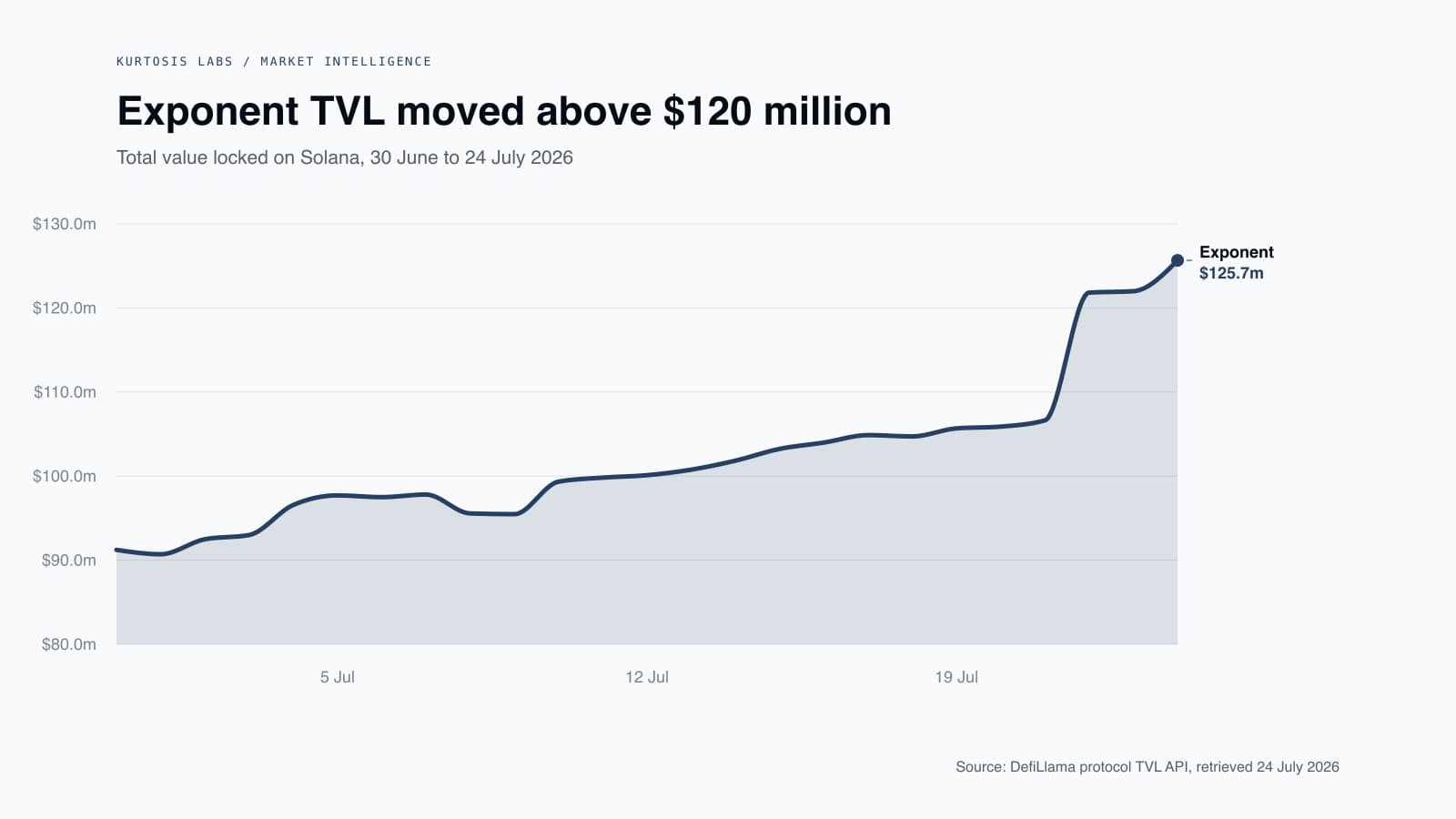
Kurtosis chart using DefiLlama data. Exponent total value locked on Solana from 30 June to 24 July 2026; retrieved 24 July 2026.
Visa launches stablecoin platform
Visa is addressing the operational layer around stablecoin yield. Its Visa Stablecoin Platform, announced on 16 July and now in limited beta, gives eligible institutions one environment to mint, redeem, hold and transfer Open USD. Clients can connect bank accounts, set user permissions and require dual approval for sensitive actions. Visa also offers wallet infrastructure with passkey signing, audit logs and destination allowlists.
That design could make reserve-bearing stablecoins easier to use inside treasury and settlement systems without asking every institution to assemble custody, controls and fiat connectivity separately. Open USD adds an unusual economic incentive. Open Standard says businesses can mint and redeem it without fees or artificial volume caps, while participating partners receive reserve earnings after a management fee. More than 140 businesses have signed on, including banks, payment networks and onchain protocols.
The distribution promise still runs ahead of the asset. Open USD is scheduled to go live later this year, Visa's access remains subject to volume and geographic limits, and API access is still forthcoming. Reserve income flows to participating partners rather than automatically to token holders. The near-term signal is therefore infrastructure readiness, not proven circulation or end-user yield.
FDIC aims to tighten regulations
The FDIC's proposed reporting forms show what regulated stablecoin balance sheets may soon need to reveal to supervisors. Published on 20 July, the proposal would require FDIC-supervised payment stablecoin issuers to file confidential weekly reserve reports and quarterly financial reports. Issuers with at least $1 billion outstanding or $100 million in prior-month average daily transaction volume would complete the full eight-schedule weekly form; smaller issuers could use an abridged version.
The full form treats reserve management as a fixed-income control problem. Treasury disclosures would include CUSIPs, fair value, remaining maturity, coupon, effective interest rate, custodian and repo encumbrance. Reverse-repo reporting would identify counterparties, cash lent, agreement type, collateral, maturity and haircuts. The FDIC also intends to publish quarterly financial information.
This would not create real-time public transparency. Weekly reports would remain confidential, the forms are still open for comment through 18 September, and a final rule could change them. Even so, standardised reserve data would make duration, liquidity, concentration and collateral practices more comparable. Stablecoin scale is pulling onchain cash management toward the reporting discipline of regulated financial institutions.
TL;DR
Capital is concentrating in structured rate products, while enterprise controls and reserve reporting are catching up. The next phase of onchain fixed income will be judged by usage, liquidity and balance-sheet discipline.
Sources
- Exponent v2 TVL update
- DefiLlama Exponent protocol data
- Visa Stablecoin Platform
- Visa platform announcement
- Open Standard introduces Open USD
- FDIC stablecoin reporting proposal
Disclaimers
This content is for informational purposes only and does not constitute financial advice. Readers should conduct their own research, exercise independent judgment, and consult appropriate professional advisers before making financial decisions. Any views expressed are those of the authors as of the date of publication and may change without notice.