Onchain Adoption Is Shifting From Access to Packaging

Galaxy paired managed DeFi credit with familiar institutional workflows, showing how distribution and risk packaging could shape the next adoption phase.
Aave introduced stable-rate vault infrastructure that lets fintechs embed predictable stablecoin earnings while the underlying market yield continues to move.
UK and US initiatives centred tokenisation on collateral eligibility, settlement finality and repo, where financial plumbing matters more than issuance headlines.
Bitcoin and ether advanced during the week, but the more consequential signal came from product design. Across a consistent seven-day window, bitcoin rose 0.4%, ether gained 3.3% and aggregate DeFi value locked increased 3.6% to $74.85 billion. Stablecoin circulation edged down 0.5% to $306.30 billion. That combination suggests improving risk appetite without net expansion in USD-pegged stablecoin circulation. The week's strongest stories were therefore not another price narrative, but three attempts to make onchain markets usable through structures that institutions and consumer platforms already understand.
Galaxy packages managed credit and curated vaults
Galaxy's two launches made that shift explicit. Galaxy Onchain Financing Rate, or GOFR, aggregates variable borrowing across Aave, Morpho, Spark and Kamino, while clients face Galaxy rather than manage wallets, keys or smart contracts. Loans begin at $1 million, and Galaxy has committed up to $100 million of its own capital as intended first-loss protection, subject to product terms. Its public rate history also shows what the managed layer packages: by 16 July, indicative rates were 3.50% for USDC, 3.44% for USDT and 1.59% for ETH, with Galaxy handling the underlying venue selection and rate changes.
Two days later, Galaxy launched Galaxy Curator, a set of Morpho vaults available through Fireblocks Earn, giving more than 2,400 institutional clients potential access inside existing infrastructure. The "Quality" configuration prioritises blue-chip collateral and capital preservation, while "Enhanced" reaches into assets such as liquid restaking tokens, Pendle principal tokens and Ethena products. The distinction is useful. Institutional access is not simply a gateway into DeFi; it is a packaged choice about collateral, counterparty exposure, yield and operational control.
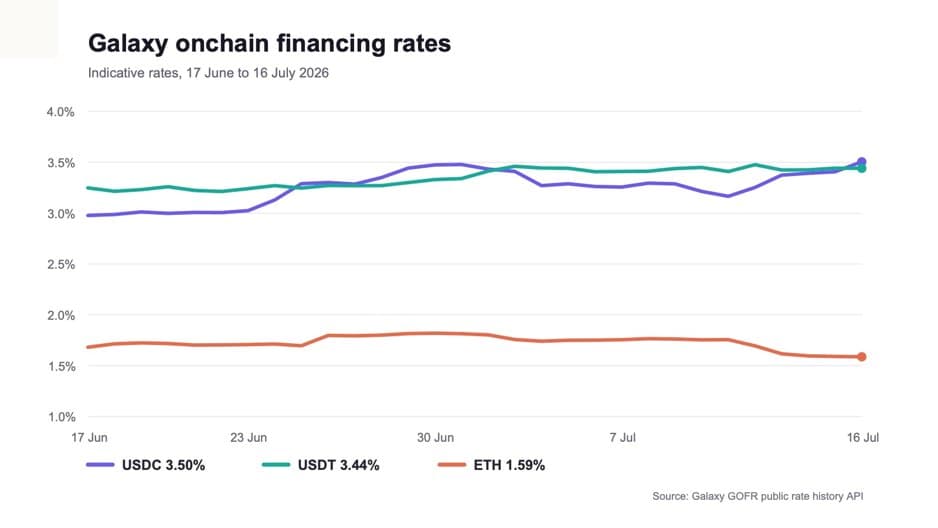
Kurtosis chart using Galaxy data. Indicative, non-binding GOFR rates for the 30 days to 16 July 2026; retrieved 17 July 2026.
Aave makes stable-rate earnings embeddable
Aave's Stable Vaults, released on 9 July, apply similar packaging to the distribution side. They are designed for fintechs to embed stable-rate earnings on stablecoins directly inside their products. A position accrues per second at an operator-set rate even though the vault's underlying market yield fluctuates, and its assigned rate configuration can later change. An offchain rebalancer allocates capital among approved yield strategies, while an authorised party may top up a shortfall or sweep surplus subject to the vault retaining enough to meet its obligations.
The commercial value is legibility: a fintech can present a rate that resembles a savings product instead of exposing users to a constantly moving DeFi annual percentage yield. The risk has not disappeared, however. It has moved behind the interface into strategy performance, rebalancing, bridge and oracle dependencies, withdrawal liquidity and surplus available to redeem interest. Stable-rate onchain products will ultimately compete on the quality and transparency of that machinery, not only on the headline number.
Policy follows the same path, toward plumbing
The same movement from assets to infrastructure appeared in policy. A UK-US taskforce recommended a one-year private-sector group to test cross-border tokenised use cases, while authorities will seek common approaches to settlement finality and the possible eligibility of stablecoins and tokenised money-market funds as central-counterparty margin collateral. Separately, a 54-firm UK programme will spend the next 12 months working to scale wholesale tokenisation, beginning with tokenised repo and spanning issuance, collateral, payment rails, legal certainty and interoperability.
This matters because tokenised assets become more valuable when they can move through funding, collateral and settlement systems, rather than merely exist on a ledger. Repo is especially revealing: it could turn tokenisation from a new wrapper for securities into an improvement to how liquidity is created and transferred. The common thread across Galaxy, Aave and the policy agenda is therefore controlled abstraction. The winning products will hide technical complexity without hiding economic risk.
TL;DR: Onchain adoption is shifting from access to packaging: managed credit, stable-rate interfaces and interoperable collateral rails are turning protocols into financial products.