Tokenized Stocks Just Had Their Liquidity Breakout

Tokenized RWA value (excluding stablecoins) sits around $31.5B on RWA.xyz distributed value, down about 1% on the month, while holders rose almost 14% over the same window. As a cross-check, DefiLlama puts RWA category TVL near $27.3B, the gap is mainly basis (distributed value vs DefiLlama TVL), so we flag it rather than pick one figure. The headline total is flat, the activity is underneath it.
This week's signal: tokenized stock trading hit an all-time high. Weekly tokenized-equity transfer volume reached roughly $2.5 to $3.6 billion, about 10 times a month ago, with Solana taking over 80% of that flow. This is the first clear sign that one RWA segment is developing real secondary liquidity, not just issuance, exactly the gap we flagged the last two weeks.
Narrative read: the conversation has flipped from "can tokenized assets trade" to "tokenized stocks are where the trading is." The same week, a crypto rebound was led by Solana DeFi tokens precisely because the tokenized-stock volume runs on Solana rails, so the narrative and the on-chain flow are pointing at the same place for once.
Segment Updates
Equities are the week's story, and a genuine break from the issuance-only pattern. Tokenized stock volume hit a record (roughly $2.5 to $3.6 billion weekly, 10x a month prior), with Solana over 80% of it. DefiLlama's research notes equities surged from about $30M to $1.3B in a year and, crucially, that Morpho integrations now let tokenized stocks (SPY, QQQ, TSLA) be used as borrowing collateral. Cause: trading-venue expansion plus collateral utility, the first segment to move from static holding to active deployment.
Treasuries remain the largest segment but were flat-to-soft this week as attention and flow rotated to equities; RWA.xyz shows tokenized Treasury activity steady with no major net-flow surge. Cause: not weakness, just that the marginal interest moved to stocks.
Private credit remains a top non-stablecoin segment; DefiLlama notes Maple's SyrupUSDC reached about $2.1B active across Pendle, Jupiter and Kamino. Cause: continued institutional credit origination and composability into DeFi venues; the standing default-risk caveat holds.
Commodities (gold) stayed steady, with no major move this week; gold tokens remain the commodity anchor with value tracking the underlying metal. Cause: a quiet week for the metal meant a quiet week for the tokens.
Frontier: New Protocols and Ideas to Watch
Securitize's public listing resolves (closing July 1), the thread we have tracked for two weeks reached its conclusion. Following lower-than-expected SPAC redemptions, Securitize expects about $400M in gross proceeds (including PIPE financing), with the Cantor Equity Partners II merger slated to close July 1 and list on the NYSE as SECZ. Why it matters: the redemption outcome was the key risk we flagged, and it came in favourably, so the leading tokenization-infrastructure provider goes public well-capitalised.
Tokenized stocks as collateral (Morpho): DefiLlama research highlights Morpho integrations enabling collateralized borrowing against on-chain stocks like SPY, QQQ and TSLA, with equity activity concentrated on Ethereum, Solana and BNB Chain, over 94% of volume. Why it matters: using a tokenized stock as loan collateral is the clearest example yet of an RWA becoming a composable building block, not just a wrapper.
Project Acacia (settlement-money models): a wholesale pilot tested four settlement-money models across 20 tokenized-asset use cases, underlining that tokenized markets stand or fall on the cash leg, how payment settles, not just the asset token. Why it matters: settlement design is the unglamorous infrastructure that decides whether tokenized trading can scale safely.
Macro Backdrop
Rate environment: Bitcoin steadied near $60,000 after this week's selloff, with DeFi and Solana-ecosystem tokens leading the rebound; the macro backdrop stays rate-sensitive, and crypto ended H1 2026 in the red. Elevated short rates keep tokenized-Treasury demand supported while pressuring longer-duration credit.
Lending and borrow rates: lending markets are increasingly central to RWA as tokenized stocks and credit become collateral. DefiLlama tracks active loans and stablecoin-pool yields across Aave, Morpho, Compound, Spark and Sky, with reputable-venue stablecoin lending broadly mid-single-digit and borrow rates floating with utilisation.
Staking rates: ETH and liquid-staking yields remain low single digits, the baseline against which tokenized-Treasury and lending yields should be read.
Phase Transitioning: Making Tokenized Assets Useful
The idea: Phase 2 is making tokenized assets useful beyond passive holding, as collateral, margin, settlement and tradable building blocks. This week delivered the most concrete evidence so far, and it is on the trading side, not just issuance.
This week's evidence: record tokenized-stock volume shows real secondary trading emerging in at least one segment, and Morpho's tokenized-equity collateral integrations show those same assets being deployed, not just held. DefiLlama frames this directly as capital moving from static exposure to active deployment. This is the buy-and-hold pattern starting to break, exactly where the academic liquidity critique said it was weakest.
The binding constraint: the breakout is narrow. It is concentrated in equities, on three chains (over 94% of volume on Ethereum, Solana, BNB), and Solana alone is over 80% of stock flow. That is real liquidity, but it is venue-concentrated and segment-specific; Treasuries, private credit and real estate still follow the issuance-heavy, thin-trading pattern. One liquid corner is progress, not a solved market, and concentration is itself the next risk.
Risk Radar
Concentration (venue): the new equity liquidity is highly concentrated, Solana over 80% of tokenized-stock flow, three chains over 94%. A problem on one chain or venue would hit most of the segment's liquidity at once; concentrated liquidity is fragile liquidity.
Synthetic vs real ownership: some tokenized-equity products confer neither equity ownership nor shareholder rights, and offshore synthetic tokens may not represent the underlying share or may use company names without approval. As volume surges, the gap between a real tokenized claim and a synthetic exposure becomes a live investor-protection risk.
Liquidity / float (still broad): outside equities, the issuance-not-trading pattern persists; most RWA value remains concentrated in a few issuers and private networks, so the broad market's liquidity has not changed even as stocks broke out.
Market / macro: crypto closed H1 2026 in the red and stays rate-sensitive; tokenized RWAs are steadier than crypto but not insulated, and a sharp risk-off would test the new, thin equity liquidity first.
Chart Of The Week
Source: RWA.xyz, Tokenized Stock Metrics, weekly transfer volume by network (distributed basis), as of late June 2026; via CoinDesk, June 26, 2026.
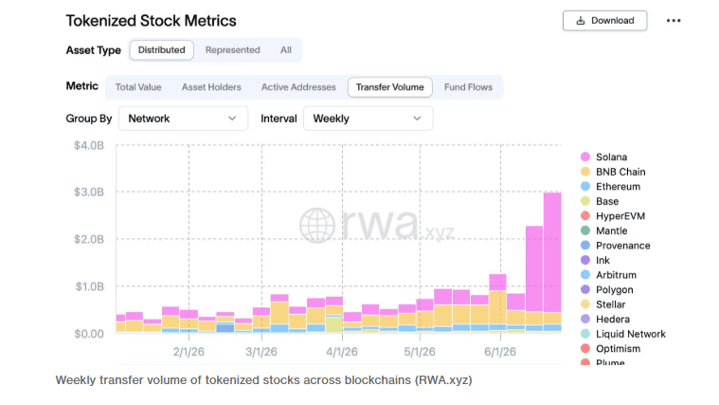
Weekly transfer volume of tokenized stocks by network. After holding near $0.5B from February through April, weekly volume broke out to roughly $3B in late June, with Solana taking the overwhelming majority of the flow. This is the record this week's brief leads with: the first segment to show real secondary trading, and how concentrated on one chain it is.
Bottom Line
For week ending June 26, the liquidity question we have pressed for three weeks got its first real answer: tokenized stock trading hit an all-time high, and tokenized equities started being used as collateral, the clearest move yet from issuance to genuine deployment. The Securitize listing resolving favourably (closing July 1) adds a well-capitalised infrastructure anchor.
What to watch: whether equity liquidity broadens beyond Solana and beyond stocks, and whether synthetic-versus-real ownership questions surface as volume grows. The constraint has shifted: this week it is no longer "is there any liquidity" but "is this liquidity concentrated and is it backed by real ownership."