Weekly at Kurtosis Labs
Market Update
- Pendle added three Morpho principal-token looping routes, making fixed-maturity claims reusable collateral for leveraged strategies funded at variable rates.
- BlackRock introduced two tokenized money-market products, separating an existing Treasury fund's wallet-based share class from a reserve-focused fund.
- CoinShares and Token Terminal reported RWA deposits into DeFi more than tripled while overall deposits fell, showing collateral utility gaining share.
Principal Tokens Enter Credit
Pendle's additions show how fixed-yield instruments become credit building blocks once lending markets accept them as collateral. A Principal Token (PT) represents the principal of a yield-bearing asset and redeems for its accounting asset at maturity. On 1 August, Pendle added PT-USD3, PT-sUSDS and PT-USDat to its Morpho looping interface, with maturities from 27 August to 17 December. A user can supply PT, borrow a stable asset, buy more PT and repeat, amplifying equity returns while the PT's implied yield exceeds the variable borrowing cost. The spread differs sharply by route. At the latest common hourly observation before the cutoff, PT-USD3 offered about 4.95 percentage points of gross carry over its Morpho borrow rate, while PT-sUSDS offered only 0.40 points before incentives, fees, slippage or liquidation costs. The latter market was 99.9997% utilized with just $8.22 of available liquidity at that moment. One-click execution compresses the transaction sequence while preserving the financing risk: rising borrow rates, PT price moves, oracle behavior and thin exit liquidity can erode carry or force liquidation. With loan-to-liquidation thresholds of 86% or 91.5% across these routes, the interface expands PT utility and makes funding discipline more important.
Tokenized Cash Splits Roles
BlackRock is treating tokenized cash as an operating-model choice with separate structures for fund distribution and stablecoin reserves. Its 3 August introduction paired OnChain Shares of the existing BlackRock Select Treasury Based Liquidity Fund with the new BlackRock Daily Reinvestment Stablecoin Reserve Vehicle. The first uses permissioned ERC-20 shares on Ethereum with BNY Mellon as transfer agent. The second uses Securitize's permissioned system across Ethereum, Tempo and Solana, with daily dividend reinvestment unless a holder elects cash. Both portfolios are restricted to cash, Treasury instruments maturing within 93 days and Treasury-backed overnight repurchase agreements. Their prospectuses say the funds intend to operate so the shares qualify as eligible payment-stablecoin reserves under the GENIUS Act, while also warning that implementing standards were unfinished and could impose different conditions. Approved wallets can transfer shares peer to peer outside fund hours, yet primary purchases and redemptions remain business-day processes and neither product provides an exchange or matching venue. The shares also retain ordinary money-market risk: the $1 net asset value is a target, losses remain possible and FDIC insurance does not apply. BRSRV had not commenced operations by its 31 July prospectus, and no OnChain balances or stablecoin allocations were disclosed by the cutoff. The structure is live as a filed product design; actual reserve use still needs a first observable balance.
RWA Collateral Gains Share
The CoinShares and Token Terminal study measures tokenization through collateral and venue use. Their 6 August report says deposits of distributed tokenized assets across lending platforms and decentralized exchanges rose from $2.3 billion in the second quarter of 2025 to $7.4 billion in the second quarter of 2026, more than tripling while total DeFi deposits fell by about 15%. The divergence supports a practical adoption thesis: wallet-transferable Treasury and multi-strategy funds, followed by private credit and delta-neutral products, can earn yield while serving as collateral or liquidity inside existing venues. That makes their utility less dependent on growth in the host market. The scope is narrower than the total RWA universe. It covers tokenized funds, stocks and commodities that can move to external wallets, and excludes networks where assets are primarily represented inside the issuing platform. Activity also remains concentrated by asset, venue and ecosystem, with limited evidence that it has changed major applications' revenue trajectory. The underlying live series has since revised its history and no longer reproduces the report's frozen endpoints, so the comparison belongs to the published study rather than a current dashboard reading. The next test is whether a reproducible third-quarter dataset shows broader collateral use and sustained share gains.
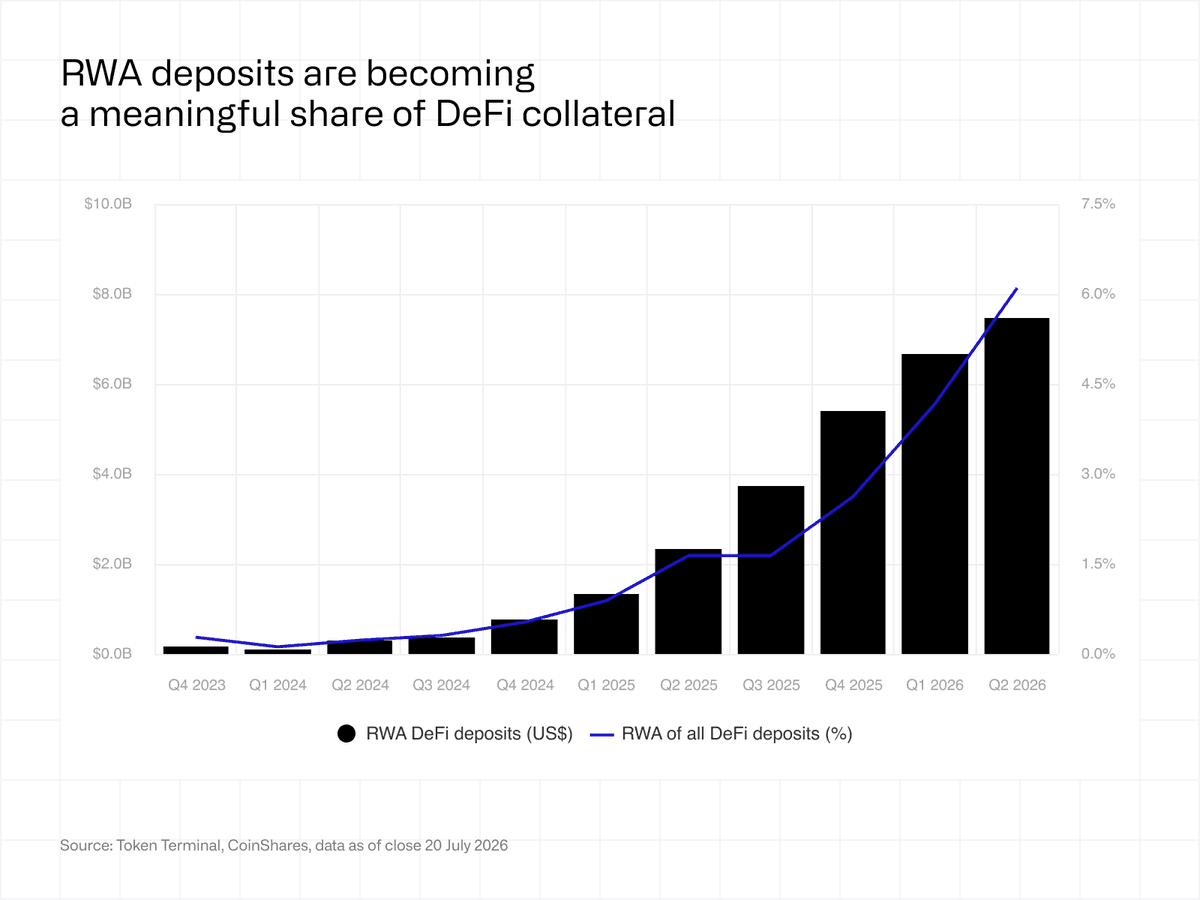
RWA DeFi deposits and their share of all DeFi deposits, Q4 2023 to Q2 2026. Source: CoinShares and Token Terminal; data as of 20 July 2026.
TL;DR
Onchain fixed income is becoming more useful as collateral and reserve infrastructure. The week's evidence also exposes the limiting conditions: variable funding, permissioned transfer, business-day liquidity and concentrated usage.
Sources
- Pendle Print #122
- Pendle documentation on PT collateral
- Morpho Blue market documentation
- BlackRock Select Treasury Based Liquidity Fund prospectus
- BlackRock Daily Reinvestment Stablecoin Reserve Vehicle prospectus
- CoinShares and Token Terminal Hybrid Finance report
About Kurtosis Labs
Kurtosis Labs develops fixed-income yield strategies for institutions onchain.
Disclaimers
This content is for informational purposes only and does not constitute financial advice. Readers should conduct their own research, exercise independent judgment, and consult appropriate professional advisers before making financial decisions. Any views expressed are those of the authors as of the date of publication and may change without notice.